

Nothing Phone (4a) Pro
Table of Contents
The Nothing Phone (4a) Pro is the kind of smartphone that makes the midrange market a little more interesting. Rather than attempting to disappear into a familiar glass-and-metal formula, Nothing has built a device around visual identity, unusual hardware touches, and software that deliberately looks different from conventional Android.
Starting at $499, the Phone (4a) Pro combines an aluminum unibody, a large 144Hz AMOLED display, Qualcomm’s Snapdragon 7 Gen 4 processor, a 5,080mAh battery, and a versatile triple-camera system. Its most recognizable feature remains the Glyph Matrix on the rear, but this generation makes that system considerably more practical instead of treating it purely as decoration.
The result is a phone that occupies an unusual position. It is more ambitious and characterful than many conventional midrange handsets, yet its processor, gaming capabilities, carrier compatibility, and repairability reveal where Nothing has made compromises to reach its price.
For buyers who want a phone with personality, those compromises may be perfectly reasonable. For shoppers who prioritize maximum software support, universal carrier compatibility, or gaming performance, the decision becomes more complicated.
Key Specifications
| Specification | Nothing Phone (4a) Pro |
|---|---|
| Starting price | $499 |
| Processor | Qualcomm Snapdragon 7 Gen 4 |
| RAM | 8GB / 12GB |
| Storage | Up to 256GB |
| Display | 6.83-inch AMOLED |
| Resolution | 2,800 × 1,260 pixels |
| Refresh rate | Up to 144Hz |
| Peak brightness | Up to 5,000 nits |
| Touch sampling rate | Up to 240Hz |
| Battery | 5,080mAh |
| Wired charging | Up to 50W |
| Rear cameras | 50MP main + 50MP telephoto + 8MP ultrawide |
| Front camera | 32MP |
| Rear zoom | Up to 3.5x optical / 140x digital |
| Water/dust resistance | IP65 |
| Wireless charging | No |
| Cellular | 5G; carrier compatibility varies |
| Wi-Fi | Wi-Fi 6E |
| Bluetooth | 5.4 |
| SIM | Nano SIM + eSIM |
| Software | Nothing OS 4.1 based on Android 16 |
| Security updates | Up to six years |
| Dimensions | Approximately 6.44 × 3.01 × 0.31 inches |
| Weight | Approximately 7.4 ounces |
Design: Industrial, Unmistakable, and Practical
Nothing continues to distinguish itself through hardware design, and the Phone (4a) Pro is arguably one of the clearest examples of that philosophy.
The phone uses an aluminum unibody construction, giving it a more substantial and premium feel than many plastic-heavy phones in this price range. The approach also changes the character of the device. Instead of feeling delicate, the Phone (4a) Pro seems designed to tolerate everyday wear. Its IP65 rating provides protection against dust and water exposure, although that should not be interpreted as permission to submerge it.
The rear panel is where the phone becomes unmistakably Nothing. Its transparent-inspired aesthetic, geometric layout, camera housing, and illuminated Glyph Matrix create an appearance that is difficult to confuse with an iPhone, Galaxy, Pixel, or conventional budget Android phone.
The trade-off is serviceability. A tightly integrated unibody construction can make internal repairs more difficult, so long-term ownership may not be as straightforward as with a device designed for easier component access.
There are three primary color choices—black, pink, and silver—and the phone includes a dedicated physical Essential Key alongside the standard power and volume controls. The buttons have a reassuring mechanical feel, while biometric authentication is handled by an optical fingerprint reader beneath the display.
As expected from a modern flagship-style phone, there is no headphone jack or microSD card slot.
The Glyph Matrix Is More Than Decoration
Previous Nothing phones used lighting extensively as part of their identity, but the Phone (4a) Pro’s Glyph Matrix is a more interesting implementation.
The rear system uses 137 miniature LEDs to produce a dot-matrix-style display. Instead of simply flashing bright strips when a notification arrives, it can communicate information such as the time, battery status, and alerts.
One particularly useful application is using the rear display as a rough framing aid when taking selfies with the primary camera. Since the rear camera system is generally more capable than the front camera, this can be genuinely useful for self-portraits or group shots.
There is also a small red indicator that can signal extremely low battery status.
The Glyph Matrix remains somewhat niche, but that is part of its appeal. It is not an essential smartphone feature, yet it provides functionality that competing phones generally do not offer.

Display: One of the Phone’s Strongest Features
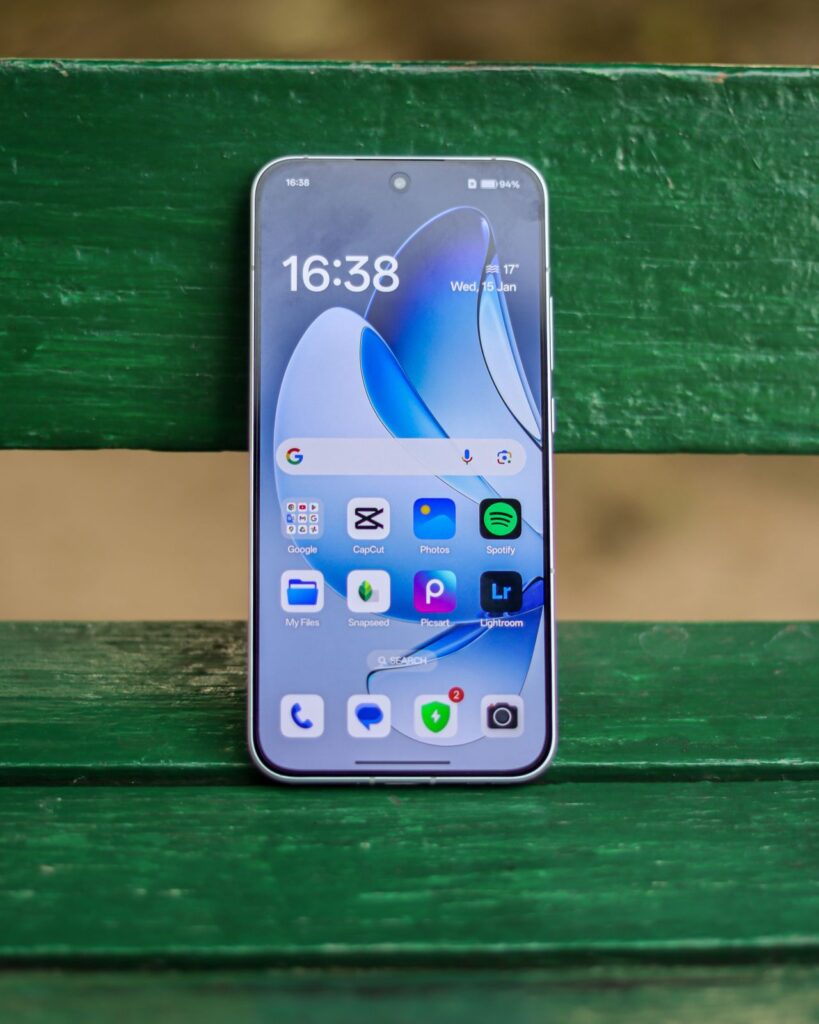
The 6.83-inch AMOLED panel is a major selling point.
With a 2,800 × 1,260 resolution, the screen offers noticeably more room and pixel density than many affordable Android phones. Text, photographs, games, and interface elements look crisp, while AMOLED technology provides the deep blacks and high contrast expected from a modern premium display.
The headline feature is the 144Hz refresh rate. Most smartphones—including considerably more expensive models—top out around 120Hz. In everyday use, 144Hz makes scrolling and animations feel extremely fluid.
The system can reduce the refresh rate when high-speed animation is unnecessary, which helps prevent the higher refresh rate from constantly consuming additional power.
Brightness is another standout feature. Nothing specifies a peak brightness of up to 5,000 nits, which gives the phone substantial headroom for outdoor viewing. Peak brightness figures do not necessarily represent sustained full-screen brightness, but the specification nevertheless indicates that the display has been designed with difficult lighting conditions in mind.
The 240Hz touch sampling rate also benefits gaming and fast interactions by allowing the touchscreen to register input more frequently.
There was an early concern surrounding low-brightness flickering associated with the display’s PWM implementation. According to the reference testing, Nothing subsequently addressed the issue through firmware, illustrating the importance of keeping the device updated.
Performance: Strong Everyday Speed, Limited Gaming Ambition
The Snapdragon 7 Gen 4 places the Phone (4a) Pro firmly in the upper-midrange performance category.
It is a significant step above the previous generation’s Snapdragon 7s Gen 4, particularly in multi-core workloads. The review testing reported a Geekbench 6 single-core score of 1,352 and multi-core score of 4,249, compared with 1,179 and 3,308 for the previous model.
The more substantial improvement appears in workloads involving several simultaneous tasks. A reported PCMark score of 15,833 also places the phone surprisingly close to some more expensive devices in general productivity performance.
In practical use, this translates into a phone that feels fast for ordinary activities. Switching between applications, browsing, social media, navigation, video editing, translation, and AI-assisted tasks should present few problems. The generous 8GB or 12GB RAM configurations also provide enough headroom for keeping several applications active.
However, benchmark numbers should not obscure the processor’s limitations.
The Phone (4a) Pro is not a dedicated gaming phone. Its 3DMark Wild Life Extreme result of 2,087, averaging approximately 12.5 frames per second, demonstrates the difference between strong everyday performance and sustained graphics performance.
Less demanding games should run comfortably, but demanding titles such as Genshin Impact may require reduced graphics settings to maintain a stable experience.
The 144Hz display therefore should not be mistaken for a guarantee of 144fps gaming. In many titles, the processor and GPU simply cannot take full advantage of that refresh rate.
Battery Life: A Major Strength
Battery endurance is one area where the Phone (4a) Pro makes a particularly strong case for itself.
The American model uses a 5,080mAh battery, and testing produced an impressive 16 hours and 51 minutes in the stated battery rundown test. After 15 hours, the device reportedly still had around 14% remaining.
That kind of endurance suggests that moderate users should have little trouble reaching the end of a full day, while lighter users may be able to stretch usage considerably further.
The phone supports 50W wired charging with compatible Nothing hardware. Even with a slower 30W charger, testing reportedly took about 66 minutes to move from 20% to full. Another test reached 84% after 60 minutes using faster charging equipment.
Importantly, charging performance appears to be reasonably thermally controlled. Power can peak at higher levels when the battery is depleted before gradually tapering as the charge approaches completion.
There is, however, no wireless charging. That’s a notable omission for buyers accustomed to placing a phone on a charging pad.
Cameras: Surprisingly Capable Zoom Photography
Nothing equips the Phone (4a) Pro with three rear cameras: a 50MP primary camera with optical image stabilization, a 50MP telephoto camera, and an 8MP ultrawide.
The camera system’s most unusual feature is its zoom capability. Optical zoom extends to 3.5x, while software processing allows the phone to advertise up to 140x digital zoom.
Extreme digital zoom figures should always be viewed cautiously. Beyond the optical range, computational processing increasingly becomes responsible for reconstructing detail rather than simply capturing it through the lens.
Nevertheless, the phone reportedly performs well enough at moderate and extended zoom levels to make the feature useful. The stabilized telephoto camera is particularly valuable because it provides genuine optical magnification rather than relying exclusively on cropping the primary sensor.
The main camera also performs well in close-up photography, where depth and subject separation can produce attractive results.
Low-light photography remains less convincing than what you would get from Google’s computational photography-focused Pixel phones, particularly in difficult scenes. Still, optical stabilization gives the Phone (4a) Pro a meaningful advantage over inexpensive cameras that depend entirely on electronic stabilization.
The 32MP front camera provides detailed selfies without excessively aggressive skin smoothing. Video recording includes 4K at 30fps, while 1080p recording can reach 120fps for slow-motion footage.
One caveat is Nothing’s AI image processing. Computational tools can sometimes become too aggressive, particularly when attempting to identify or reconstruct distant subjects. For unusual subjects such as aircraft, manually disabling AI enhancement may produce a more natural result.
Software: Nothing’s Android With Personality
The Phone (4a) Pro runs Nothing OS 4.1 on Android 16.
Nothing’s software remains one of the phone’s defining characteristics. Icons, widgets, typography, animations, and system elements are designed around the company’s minimalist visual language rather than simply reproducing Google’s standard Android interface.
The result is cohesive without being excessively intrusive.
The Essential Key provides quick access to Essential Space, a feature set built around productivity and AI-assisted functions such as transcription and summaries. Users can also remap the button to a third-party application, making it more useful for people who have a preferred shortcut.
AI features are present throughout the experience, including image editing and integration with selected Google AI functions such as Circle to Search. However, Nothing’s approach is relatively restrained compared with phones that place AI at the center of almost every system function.
Software support is another consideration. Nothing promises six years of security updates, while the major Android-version update commitment is shorter. Buyers who keep phones for many years should therefore examine the exact update policy alongside their expected ownership period.
Connectivity: Good, But Check Your Carrier
Connectivity is an area where potential US buyers need to pay attention.
The Phone (4a) Pro can provide excellent 5G performance on compatible networks. Testing on Mint Mobile, which uses T-Mobile’s network infrastructure, produced download speeds of 463Mbps and upload speeds of 39Mbps in the reported tests.
But compatibility is not universal.
T-Mobile-based service is the safest fit from the information provided. Verizon support is more problematic, while AT&T users may face limitations because the phone does not support mmWave.
This is an important distinction from some competing midrange phones that are designed to work broadly across US carriers.
For Wi-Fi, the device supports Wi-Fi 6E, while Bluetooth 5.4 and NFC cover modern wireless accessories and contactless functions.
Audio: Loud Enough for Almost Anything
The stereo speakers provide clear enough sound for podcasts, videos, calls, and casual music listening. However, maximum volume can become excessively sharp, particularly with recordings containing lots of high-frequency sound.
The phone’s speakerphone performance is similarly powerful. That’s useful in noisy environments, although users should avoid holding the earpiece close to the ear at unusually high volume.
The absence of a 3.5mm headphone port means wired headphones require an adapter or USB-C connection.
Pros and Cons
Pros
- Distinctive aluminum design unlike most competing phones
- Useful and innovative Glyph Matrix
- Excellent battery endurance
- Fast 144Hz AMOLED display
- Strong everyday Snapdragon 7 Gen 4 performance
- Versatile telephoto camera
- Optical stabilization on the main and zoom cameras
- Fast 50W wired charging
- Clean, highly customized Nothing OS experience
- Six years of security updates
Cons
- No wireless charging
- Difficult internal repairability
- Gaming performance does not match the 144Hz display’s potential
- Carrier compatibility can be limited in the US
- Night photography trails the strongest computational-photography competitors
- No microSD expansion
- No headphone jack
- AI photography can occasionally over-process unusual subjects
Who Is This For?
The Nothing Phone (4a) Pro makes the most sense for buyers who want a smartphone that feels different.
It is particularly appealing to:
- Design-conscious users who are tired of interchangeable smartphone designs.
- Heavy daily users who value long battery life and a large, smooth display.
- Mobile photographers who want a useful telephoto camera without paying flagship prices.
- Android enthusiasts who appreciate a customized interface rather than completely stock Android.
- Frequent travelers who benefit from long endurance and fast charging.
- Users who enjoy experimentation, particularly the Glyph Matrix and Essential Key.
It is less suitable for:
- Hardcore mobile gamers who need sustained high frame rates.
- Buyers tied to a carrier with limited Nothing compatibility.
- People who require wireless charging.
- Long-term repairability advocates who prioritize easy component replacement.
- Photography purists who want the strongest possible computational night photography in this price range.
Final Verdict
The Nothing Phone (4a) Pro succeeds because it does not try to be a generic $499 Android phone.
Its combination of an aluminum body, striking rear design, functional Glyph Matrix, excellent AMOLED panel, long battery life, capable cameras, and distinctive software gives it a clear identity. The Snapdragon 7 Gen 4 provides enough performance for demanding everyday use, even if it falls short of what serious gamers need.
The biggest practical concerns are equally clear. Wireless charging is absent, internal repairability is compromised by the unibody construction, and US carrier compatibility requires more research than with some mainstream alternatives. Camera performance is good rather than class-leading, particularly at night, while Nothing’s software-update policy does not completely match the longest commitments in the market.
Ultimately, the Phone (4a) Pro is best understood as an upper-midrange phone built around personality as much as specifications. It offers enough hardware capability to avoid feeling like a style-first compromise, while its unusual design and software make it immediately recognizable.
For someone who wants the safest, most conventional smartphone experience, there are more straightforward choices. But for tech enthusiasts who want strong battery life, a superb high-refresh-rate display, capable cameras, and a phone that actually looks and behaves differently from the crowd, the Nothing Phone (4a) Pro presents a compelling alternative at the $499 starting point.